Basement Wall Repair in Des Moines: Cracks, Bulges and Shifts
Basement wall repair in Des Moines comes down to one force: wet, heavy, sometimes frozen soil pressing on the outside of a wall. The pattern of the cracks tells you whether that push has started to win.
Sealing or injecting one wall crack costs $200–$1,000 in Fixr's 2026 guide. Stabilizing a wall that bows inward runs $4,000–$15,000, carbon fiber strips $4,000–$12,000, and helical tiebacks $1,500–$2,000 apiece. A wall that has moved too far to brace is dug out and rebuilt, which costs more than any of those bands.
Which basement wall cracks need a specialist?
- A long sideways crack in block, usually several courses below the top: soil pressure from outside. Check whether the wall above it tips into the room.
- Stair-step cracks through the mortar joints: either the same inward push or a corner that has dropped. A level held against the wall helps tell the two apart.
- Block that has slid inward at the bottom, leaving a ledge along the floor: the wall has sheared at its base.
- A hairline vertical crack in a poured wall: often shrinkage from curing. Leave it if it stays thin and dry; seal it if it seeps.
- Soft mortar, loose brick or broken tile in a prewar basement: decades of moisture more than a single event.
How is a bowing basement wall braced?
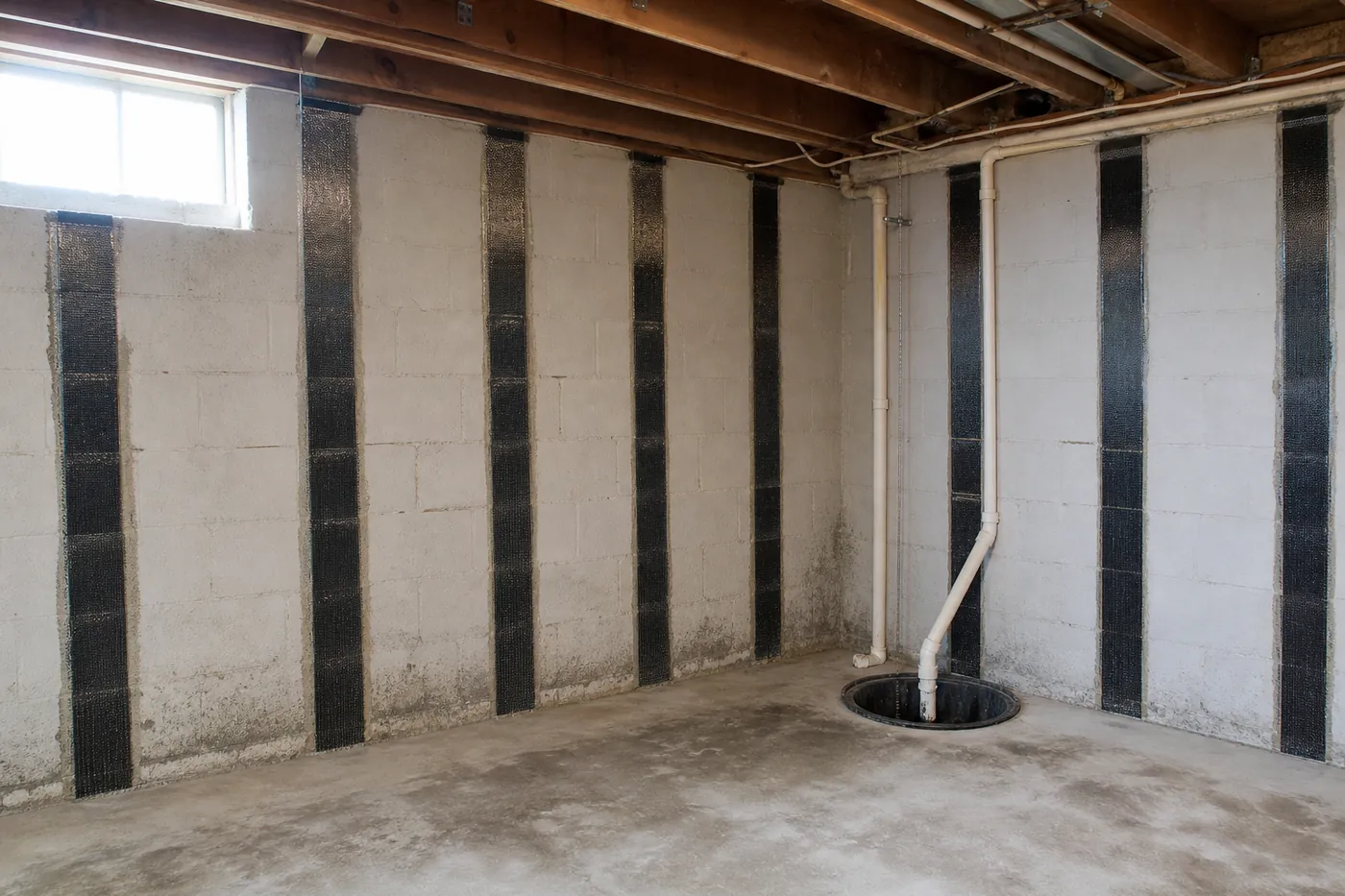
Carbon fiber strips are bonded to the inside face with epoxy, spaced along the wall from floor to joists. They are slim and suit walls that have moved only a little.
Steel I-beam braces stand against the wall and bolt to the floor and the framing above; some designs can be tightened later.
Wall anchors run a rod through the wall to a plate buried in the yard. Helical tiebacks are screwed into the soil outside instead, which needs less digging.
Excavation and rebuilding is for walls past bracing: the soil comes off the outside, the wall is straightened or relaid, and drain tile goes in before backfill.
A crack in a poured wall that only leaks can be injected: epoxy bonds it, polyurethane foam flexes and stops water. Neither stops a wall from moving.
Why Des Moines walls take a beating
Half of the city's homes were built before 1960 and about 27% in 1939 or earlier (U.S. Census ACS 2020–2024), so many basements are block, tile or brick, which resist weight from above far better than a push from the side. April through June brings about 14.5 inches of precipitation at the airport, and the low drops to freezing on about 128 nights a year (NOAA 1991–2020 normals). Shrink-swell is the second most common soil limitation for basements in Polk County, after a shallow saturated zone (USDA NRCS). Iowa's Department of Public Health also lists cracks and hollow block walls as radon entry points, so test after the repair.
What to record before anyone visits
Stretch a string line from the top of the wall to the floor and measure how far the middle sits from it. Pencil a short line and the date at each end of every crack, then look again after a thaw or a hard rain. Note where the nearest downspout empties. With those notes in hand, compare methods in the 2026 price bands for wall bracing and anchors.
Questions homeowners ask
Will carbon fiber hold a block wall that leans a lot?
Strips suit walls with limited movement. A wall that has already moved further usually needs anchors, steel braces or rebuilding. Ask the specialist to measure the lean and explain the limit for the product they propose.
Tell us what you're seeing at home
A line or two is enough: the crack, the damp spot or the sunken slab, and roughly where it is. One independent foundation specialist who works in Des Moines will call you to talk it through and arrange a visit.